


Removal of metallochlorine from water

What is Metolachlor and why is it a problem?
The metolachlor (metolachlor) is a selective herbicide from the chloroacetamide group, used in crops such as maize, soybean, or cotton. Although effective against weeds, its use poses significant risks to the environment and health.
Its sale has been prohibited since 2024, but its persistence in soils and subsequently in aquifers makes it a difficult micro-contaminant to eliminate.
Metalocloro se utiliza para controlar una amplia gama de gramíneas anuales y algunas malas hierbas de hoja ancha en cultivos como el maíz, la soja, el algodón y la caña de azúcar. Es un herbicida pre-emergente, lo que significa que se aplica a la tierra antes de que las malas hierbas o los cultivos germinen. Metalocloro actúa inhibiendo la división celular en las raíces de las plántulas, impidiendo así su crecimiento.
- Common nameMetolachlor
- Chemical formulaC₁₅H₂₂ClNO₂
- Physical stateViscous pale yellow liquid
- SolubilityModerately soluble in water, high solubility in organic solvents
- Mode of actionIt inhibits the biosynthesis of lipids and proteins in germinating seeds, interfering with the cellular growth of weed seedlings.

Main characteristics of Metolachlor
- ApplicationPre-emergent is applied, meaning before the weeds germinate.
- Persistence: Its persistence in soil exceeds 64 days. It is fairly stable in the light, with a reduction of 4% over 100 days. Half-life: 22 days in summer and 205 days in winter; if dissolved organic matter is also present, the half-life can be extended by a factor of 2 to 3.

Regulation of Methoxychlor in Europe
The regulation of metolachlor in Europe has been subject to review due to its potential impacts on the environment and human health, particularly in relation to Groundwater contamination and its potential as an endocrine disruptor.
The decision not to renew their approval was made by Implementing Regulation (EU) 2023/1453, dated 14 July 2023. The reason was concerns related to residues and metabolites in groundwater exceeding acceptable levels (0.1 µg/L), posing a risk to human health.
Latest permitted date of usegenerally until April 2024, although this may vary slightly by country.
Contamination of Aquifers by Metabolites: The Case of ESA-Metachlor
Metolachlor metabolites are identified (such as ESA-metolachlor y Metolachlor) in groundwater at concentrations exceeding legal limits.
ESA-Metolachlor (Metolachlor ethane-sulfonic acid): This is the metabolite most commonly detected, and as it is highly polar, activated carbon is no longer the most suitable treatment for its removal.
- Molecular formulaC₁₃H₂₀ClNO₅S
- Molar mass~337.82 g/mol
- Main functional groupEthanesulfonic acid–CH₂CH₂SO₃H)

Soluwater PW Technology: Treatment Efficient and safe.
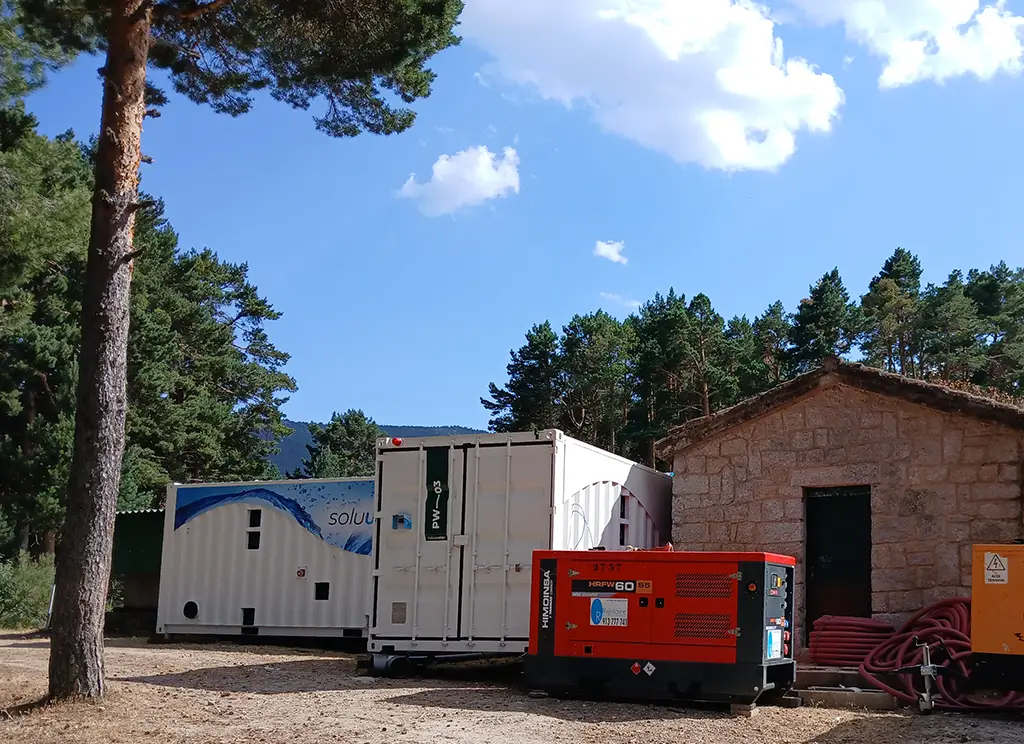
Ours Mobile PW (Process Water) treatment plant offers a comprehensive solution for the removal of metalochlor and its derivatives through a combination of advanced processes.
Removal of metaclass
Stage 1: Primary oxidation
-
Ozone (O₃)
-
H₂O₂ + O₃ (hydrogen peroxide + ozone)
Objective: to degrade ESA-metalochlor and form by-products such as nitrosamines, chloroacetaldehydes and carboxylic acids.
01
Stage 2: Secondary oxidation.
UV + H₂O₂ + O₃
This stage breaks down as follows:
-
Nitrosamines → NO₂
-
Chloroacetaldehydes → Chlorides, glycolic acid, and CO₂
The Carboxylic acids (such as oxalic and formic) remain as control compounds, no detectable toxic effects.
| Metalochlor ESA | Estimated oxalic acid | Effects |
|---|---|---|
| 0.1 µg | 0.035 µg | No effects |
| 0.3 µg | 0.104 µg | No effects |
| 0.6 µg | 0.208 µg | No effects |
| 0.9 µg | 0.312 µg | No effects |
02
Final Stage filtration and adsorption
-
Coagulation + filtration
-
Granular activated carbon
Complement the process, ensuring the quality of the treated water.
03
Do you need to remove metalochlor from your water?
Soluwater PW it is the definitive solution for eliminating metalochlor and its metabolites in groundwater. Thanks to its multi-stage technology, it offers Safety, regulatory compliance, and sustainability on a single machine
- Ozone Oxidation
- Advanced Oxidation: H2O2 + O3
- Coagulation and filtration
- Advanced Oxidation: UV+H2O2+O3
- Granular Activated Carbon.


Sources consulted
- https://pubchem.ncbi.nlm.nih.gov/compound/Metolachlor_esaChemSpider
- https://www.chemspider.com/Chemical-Structure.4932269.html
- https://sitem.herts.ac.uk/aeru/ppdb/en/Reports/1031.htm
- https://sitem.herts.ac.uk/aeru/ppdb/en/Reports/1031.htm
- https://www.chemicalbook.com/ChemicalProductProperty_EN_CB0972576.htm
- https://pubs.acs.org/doi/10.1021/jf0635762
- https://www.sciencedirect.com/science/article/pii/S0269749122009721
- https://link.springer.com/article/10.1007/s11356-025-35979-3



 English (UK)
  Español
  Português
  Deutsch
  Français
  Svenska
  Italiano